Taxonomies
A taxonomy represents a hierarchy of classification tags made up of one or more levels of tags. It provides a structured view of one or more document collections Once source data has been ingested, the resulting Documents are stored in a Collection. Once Documents are stored in a Collection, you can browse, search and edit Documents. Only text-based Documents is stored in Collections, not the original source files. by dividing documents into different classification groups. Taxonomies do not contain document collections. Collections are remembered as mappings only. Taxonomies are designed to collaborate with Structured Classifiers to create and refine document classification tags.
In a taxonomy, taxonomy tags are organised as a tree of taxonomy nodes. Each level of the tree represents a classification group associated with a particular tag category.
A taxonomy tag is a classification label given to a particular tag category (a level on the taxonomy). The same taxonomy tag may be present in different branches on the same level, each as a separate taxonomy node.
Taxonomy tags on the same level are mutually exclusive, that is, any single document should have a single unique tag for each taxonomy level.
A taxonomy node is an instance of a taxonomy tag positioned on the tree. A taxonomy node is identified by having a path from root to its location across different levels of taxonomy tags.

The Taxonomies screen
-
Configuration - this pane shows mappings to document collections Once source data has been ingested, the resulting Documents are stored in a Collection. Once Documents are stored in a Collection, you can browse, search and edit Documents. Only text-based Documents is stored in Collections, not the original source files. and enables you to edit levels, hierarchy and tags.
-
Documents list - this pane displays documents on a node of the taxonomy and displays search results.
-
Document view - this pane displays the content of a document.
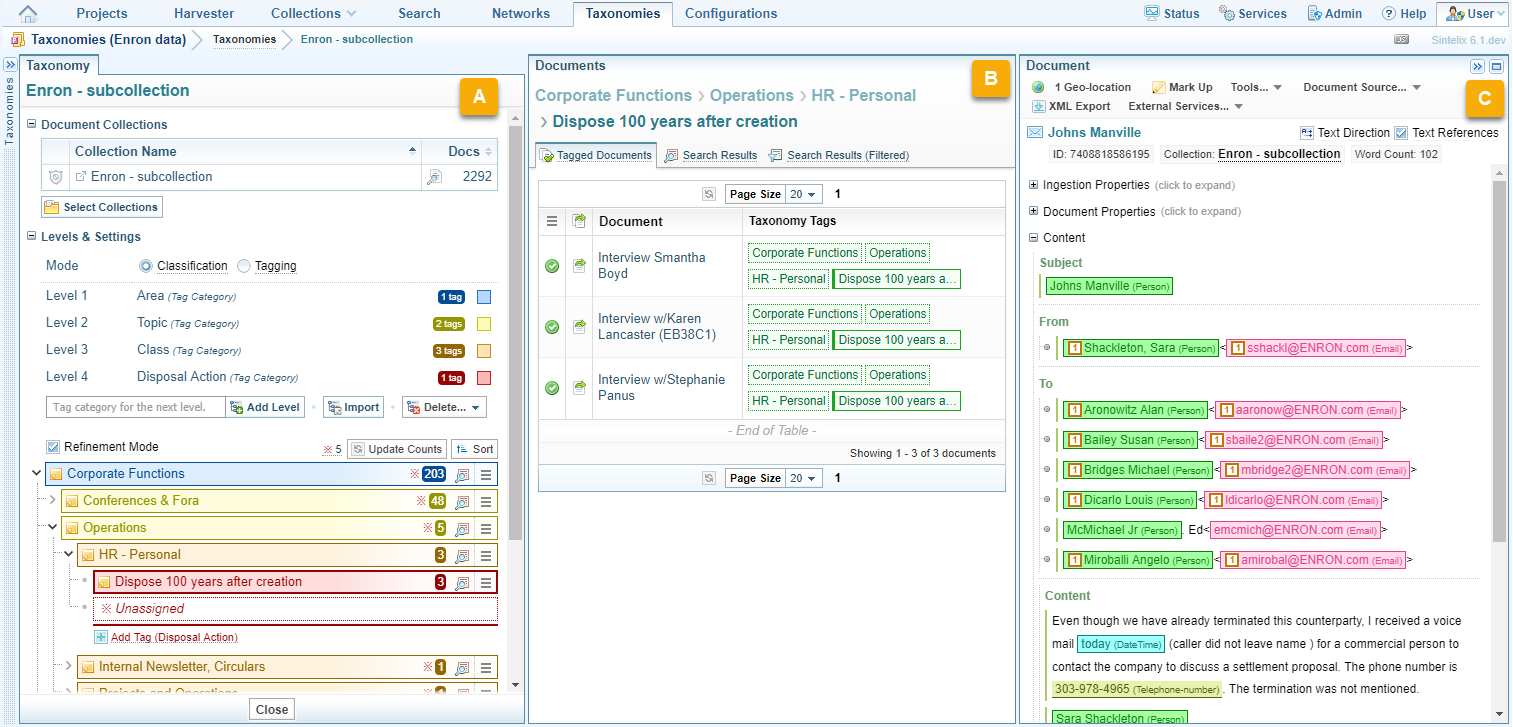
In the Taxonomy scree, the selected Taxonomy Node in pane A has the following properties:
-
It is at Level 4, associated with the Disposal Action tag category.
-
It has the Taxonomy Tag = Dispose 100 years after creation.
-
It is identified by the taxonomy tag path: Corporate Functions > Operations > HR - Personal > Dispose 100 years after creation.
Multiple documents can be assigned to a Taxonomy Node (see Assign documents to Taxonomies).
Designing and creating taxonomies
Creating a taxonomy
To create a taxonomy:
- Open the project in which you want to create a taxonomy.
- On the Main Navigation bar, select Taxonomies.
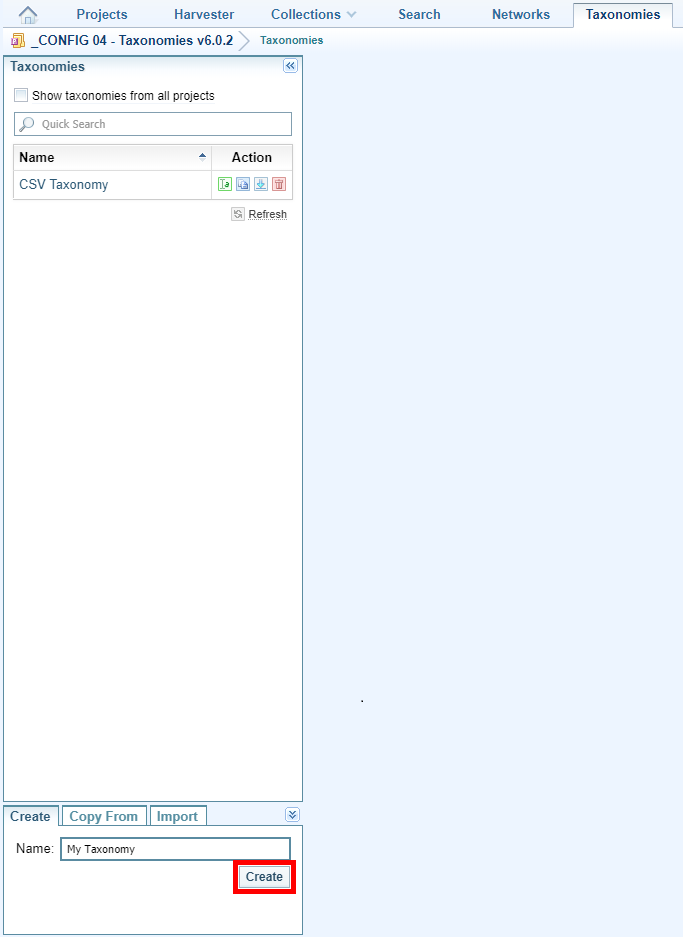
- In the Create tab, at the bottom of the pane, enter a name for the taxonomy, then select Create.
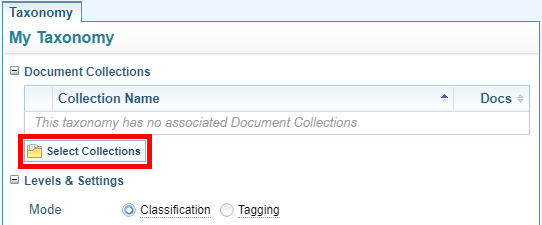
- Click Select Collections then select the collection or collections you want to link to the taxonomy.
-
To delete or remove a collection from the list, click Select Collections then the delete symbol beside it. Select Save.
- On the Main Navigation Bar select Taxonomies.
- Select the taxonomy mode:
- Classification mode enables a document to be assigned a single tag at each level. As a result, the document can be assigned at one position in the taxonomy tree. When a document is given a different tag, its old tag is replaced. Classification mode can be used to design structured classifiers.
- Tagging mode enables a document to be assigned multiple tags at each level. As a result, the document can be assigned at multiple positions in the taxonomy tree. When a document is given a different tag, its old tag is not affected. Tagging mode cannot be used to design structured classifiers.
- Enter the name of the first taxonomy level, then select Add Level. The name of the level is the name of the Tag Category in which classification tags are stored in the documents. Add more levels, as required.
- To import a taxonomy from a CSV file select Import, then Choose file. Locate the CSV file and select Open > Import. For information on the required format of the data in the CSV file see Import taxonomy tags from a CSV file.
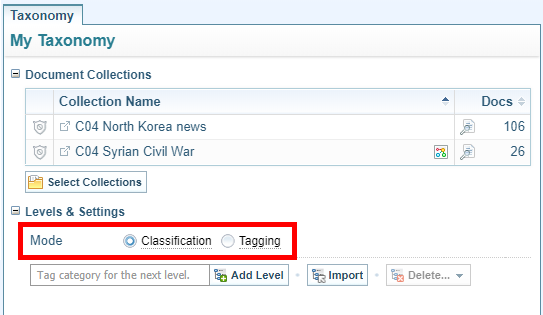
In the Levels & Settings section:
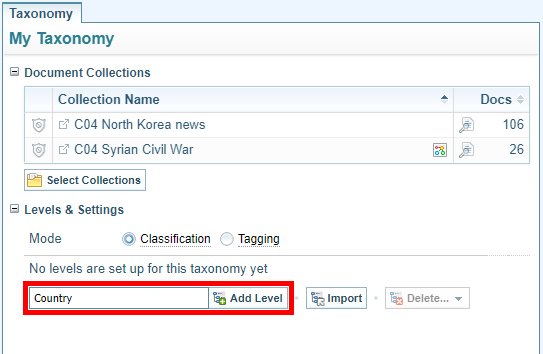
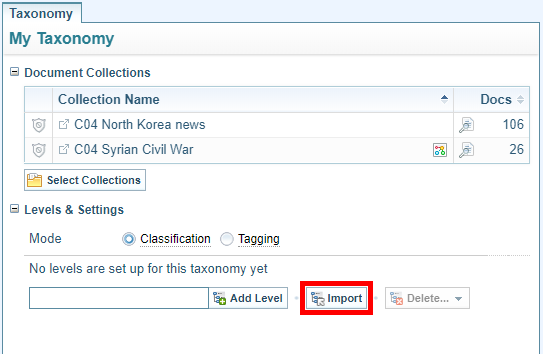
You can now:
If you need more vertical space to edit the taxonomy, collapse the Document Collection and/or Levels & Settings sections.
Add a taxonomy tag to a level
To add a taxonomy tag to a level:
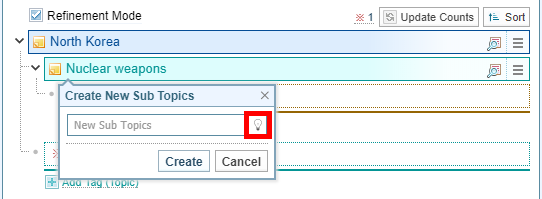
- Select Add Tag, enter a name for it then select Create.
- Add other tags as required for each level.
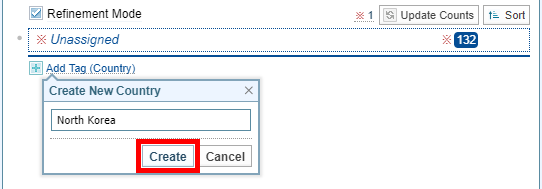
The new tag is added as taxonomy node.
You can select previously used tag names from other branches of the same level by selecting the  bulb icon.
Add a child tag
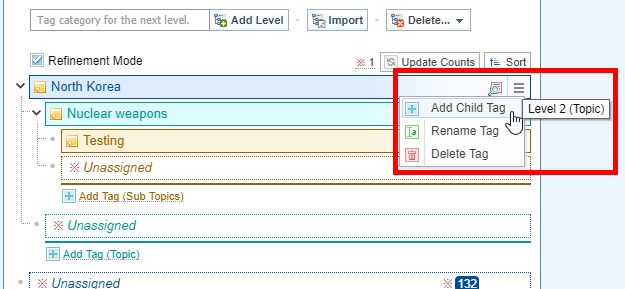
To add a child tag under the current node:
Select the Action menu  at the right side of the parent tag name, then Add Child Tag. This function behaves the same as creating a taxonomy tag and, in certain situations, means that you can create a tag without having to scroll to the bottom of the branch.
Rename or delete a taxonomy tag
To rename or delete a taxonomy tag:
Select the Action menu at the right side of the tag name, then Rename Tag or Delete Tag.
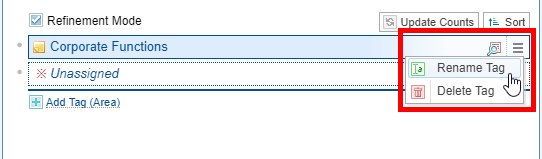
If you rename a tag, document tags on the corresponding documents will also be renamed. If you want to keep them, create a new tag instead.
If you delete a tag, document tags on the corresponding documents for that branch will also be deleted.
Managing taxonomies
Open a taxonomy
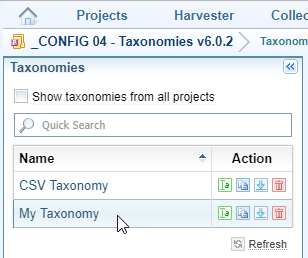
To open a taxonomy:
On the Taxonomies tab, select the name of the taxonomy you want to open.
Rename a taxonomy
To rename a taxonomy:
- On the Taxonomies tab, select Rename beside the taxonomy you want to rename.
- Enter the new name for the configuration then select Rename.
When you copy a taxonomy, the copy remains mapped to the document collections of the source taxonomy so edits on the documents will be reflected in the original taxonomy. If complete isolation is required, you may make a copy of the underlying document collections, then change the copied taxonomy to link to new document collections. These operations do not apply to document collections referenced by the taxonomy.
Copy a taxonomy and save it in the current project
To copy a taxonomy and save it in the current project:
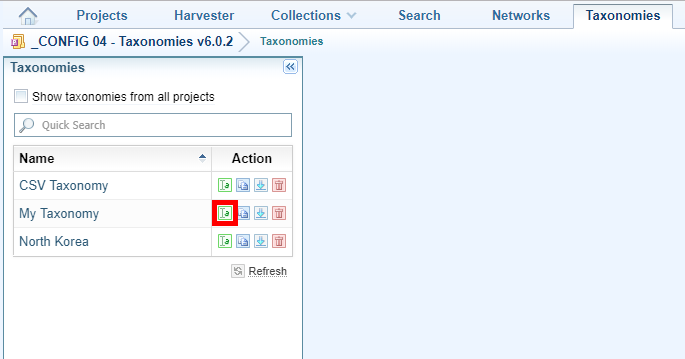
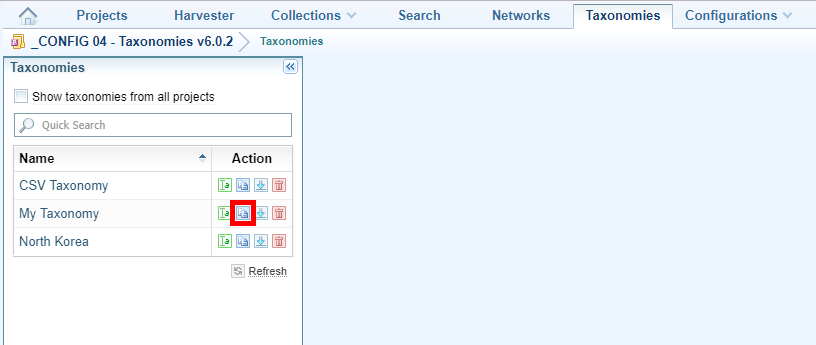
- On the Taxonomies tab, select the Create a copy
 icon beside the name of the taxonomy.
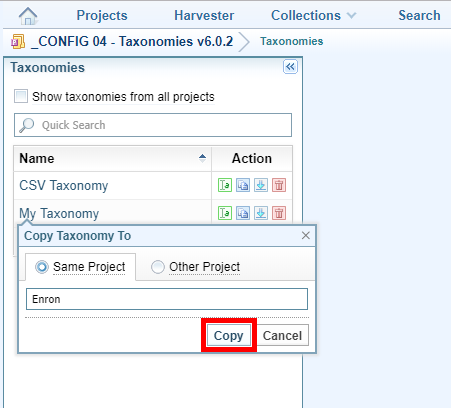
 - Make sure Same Project is selected.
- Enter a name for the new taxonomy, then select Copy.
Copy a taxonomy and save it in another project
When you copy a taxonomy, the copy remains mapped to the document collections of the source taxonomy so edits on the documents will be reflected in the original taxonomy. If complete isolation is required, you may make a copy of the underlying document collections, then change the copied taxonomy to link to new document collections. These operations do not apply to document collections referenced by the taxonomy.
To copy a taxonomy and save it in another project:
- On the Taxonomies tab, select the Create a copy icon beside the name of the taxonomy.
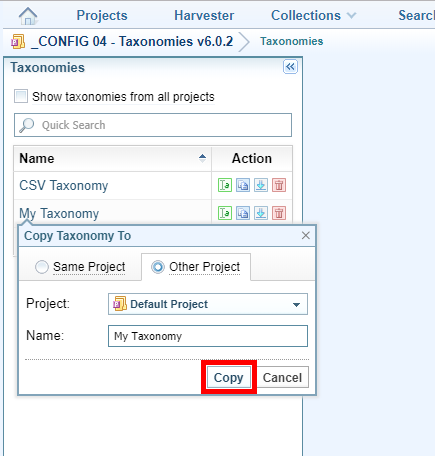
- Select Other Project then select the project you want to copy the taxonomy to.
- Enter a name for the taxonomy then select Copy.
Copy a taxonomy from another project into the current project
When you copy a taxonomy, the copy remains mapped to the document collections of the source taxonomy so edits on the documents will be reflected in the original taxonomy. If complete isolation is required, you may make a copy of the underlying document collections, then change the copied taxonomy to link to new document collections. These operations do not apply to document collections referenced by the taxonomy.
To copy a taxonomy from another project into the current project:
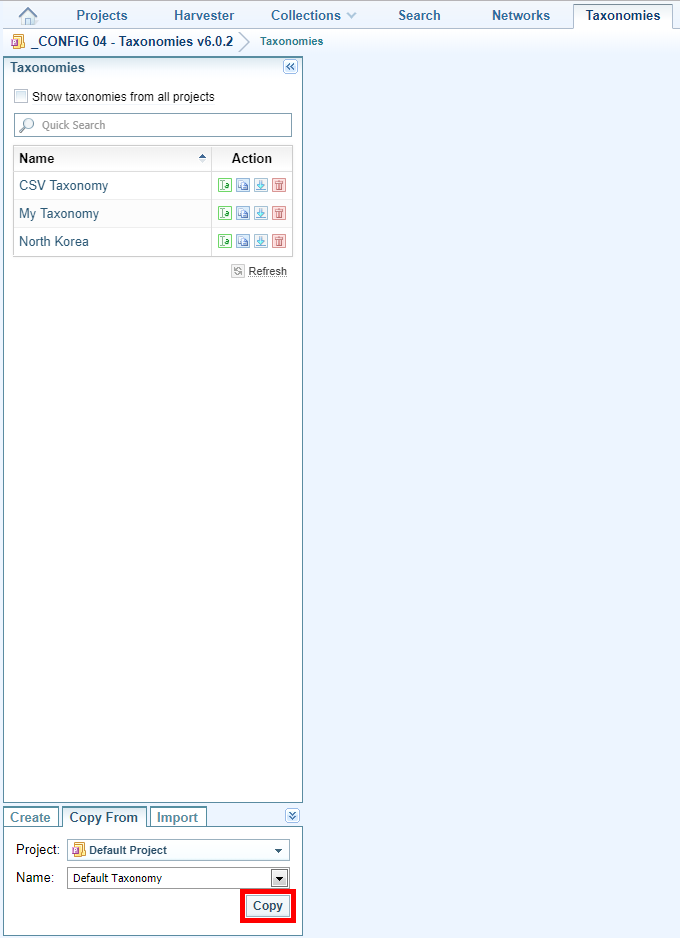
- On the Taxonomies tab, go to the Copy From tab.
- Select the project the taxonomy is in, select the name of the taxonomy you want to copy, then select Copy.
Export a taxonomy
When you export a taxonomy only the taxonomy itself is exported, not documents and collections.
To export a taxonomy with document collections, export the whole project (not only the taxonomy).
To export a taxonomy:
On the Taxonomies tab, select the Export icon  beside the taxonomy you want to export.
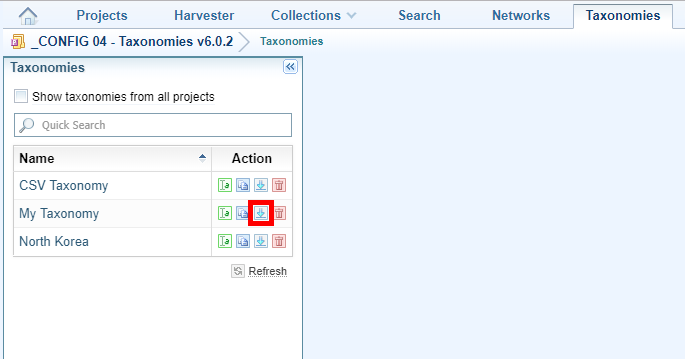
The taxonomy is exported to your downloads folder.
Import a taxonomy
When you import a taxonomy only the taxonomy itself is imported, not documents. If you want to import a taxonomy with document collections, import the whole project (not only the taxonomy).
When you import a taxonomy, mappings to document collections are also imported. If any document collections with the same names are found, the mappings are re-associated with those collections even though their contents may be entirely different to the original collections.
To import a taxonomy:
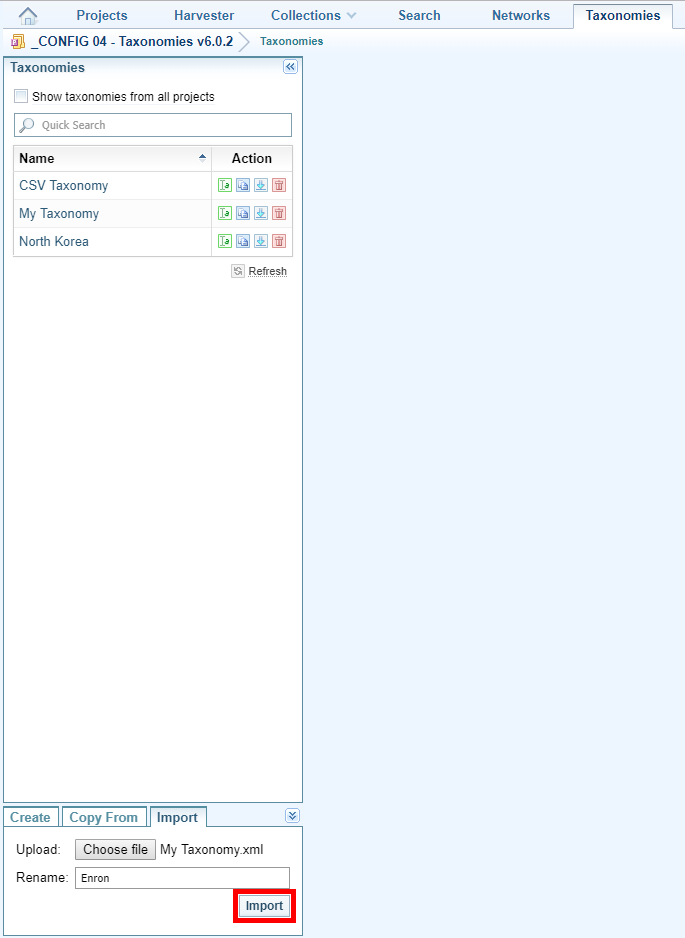
- On the Taxonomies tab, go to the Import tab.
- Select Choose file, navigate to the file, then click Open.
- Rename the file, if necessary, then select Import.
Delete a taxonomy
When you delete a taxonomy the mapped document collections and their document tags are not deleted.
When you delete a taxonomy you cannot undo the action.
To delete a taxonomy:
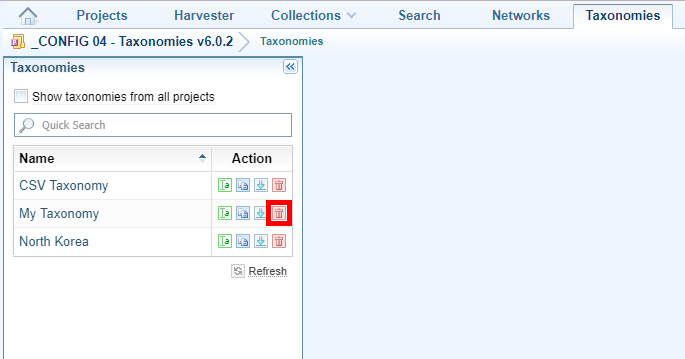
- On the Taxonomies tab, select the Delete icon
 beside the taxonomy you want to delete.
 - Confirm that you want to delete the taxonomy by selecting Delete or Delete & Close.